

In her fourth collection of poetry, Questionable Baggage, Marci Rae Johnson emphasizes the absurdity of our lives. She focuses on trying to remain faithful in the face of ambiguous feelings and experiences we all have—our questionable baggage. Johnson makes the dual meanings of the words “questionable baggage” central to the book. Travelers take “baggage” with them into the future both willingly and unwillingly. Unwilling “baggage” contains the things holding a traveler back or weighing them down. Additionally, Johnson uses the word “questionable” to emphasize the idea that not all of the baggage that we take with us is something that we are proud of.
Johnson divides the collection into four distinct sections, each with a different context in which we can think about the “baggage” in our lives: the first is concerned with what people may bring with them to the apocalypse; the second, what humanity may leave behind after the apocalypse as proof of its existence; the third, thoughts and feelings that drag behind us, like a heavy suitcase; and the fourth, the possessions we choose to take with us revealed through thought-provoking irony. Johnson’s poems feature a wild assortment of subjects, from “1960’s Viewmaster slides” to “Praying Naked” to the “Rapture,” and frequent cameos by Christ appear in this rollercoaster of a collection, all motivating readers to examine the lives they have lived.
—Isaac Chernobilsky

In Dana Delibovi’s bilingual collection of translations of St. Teresa of Ávila’s poems, she carefully preserves the villancico form with an effort to convey both the sound and sense of St. Teresa’s original poems. Readers follow a spiritual journey where, like Delibovi herself, they can create an intimate relationship with God.
In her introduction to section two of the collection, entitled “O Sisters,” Delibovi explains that the poems in this group “offer an instruction manual for monastic life” that emphasizes the need to practice what St. Teresa called the “two inseparable sisters” of “detachment and humility,” which guide the soul to encounter the fullness of God’s presence. Humans are attached to the material world, which can lead to living a life of self-fulfillment. These poems offer redirection and serve as a guide for the soul’s return to God. In “At the Vows of Isabel De Los Ángeles,” the speaker begins,
Let weeping be my joy,
let shock be my repose,
let pain be my peace,
and losses, my gain.
and ends with “Here lies my firmness, / here lies my shield, / . . . / the mark of my grace.” The repetition of “let,“ “my,” “here,” and “lies” are intentional not only to help readers develop an intimate connection to the poem itself, but also to honor the villancico form of Ávila’s original poem, with its songlike qualities. By embodying the spiritual experience of this prayer in sound, Ávila’s poems remind us that God is not a feeling, but a presence revealed through discipline and repeated prayer.
—Jezabel Fernandez
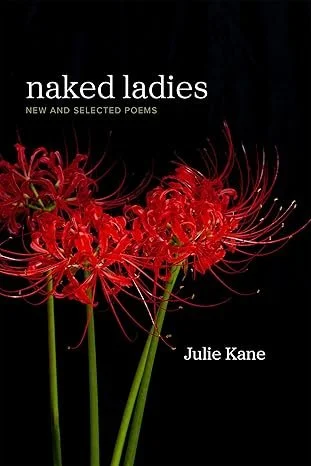
Throughout the decades of writing in Julie Kane’s Naked Ladies: New and Selected Poems, we find that she has experimented with various poetic styles, with both tight formal poetry and free-form confession. Her poems reveal her Boston Irish roots and her deep love for New Orleans. But what ties Kane's poetry together is not simply a shared writing style or form, but rather a common philosophy expressed through a type of unadorned, uncompromising honesty. Her lines tend to be crisp, sparse, and rhythmic, balancing humor with ache. The reason her poems are "naked" in both the literal and figurative senses is because she refuses to dress the truth in anything more elaborate than it needs.
Kane’s poems reveal the suffering women have endured for centuries—how stories shape us long before we can shape them back. If “Thirteen” captures the awkward hope of becoming a woman, and “Inheritance” shows the burden we’re handed before we can name it, then “The Mermaid Story” reveals the myths waiting for us once we arrive in womanhood.
And this is, I think, the heart of what I love about Naked Ladies: Kane writes the body and voice as places of struggle and revelation. She exposes the uncomfortable, the unglamorous, the unvarnished. Kane writes girlhood, womanhood, aging, grief, desire, and cultural expectation with the same boldness as the title itself. By the end, I understood why the book is called Naked Ladies: these poems undress illusions, undress expectations, undress inherited narratives. They reveal the raw, contradictory, unpolished truth of being human—especially being a woman. If you’ve ever questioned the narratives that shaped you, if you’ve ever laughed at your younger self in the mirror, if you’ve ever wished for legs but kept your voice, this book will feel like a conversation you didn’t know you desperately needed. And it might even help you maybe to reclaim a little bit of the voice you gave away.
—Pratistha Ghimire
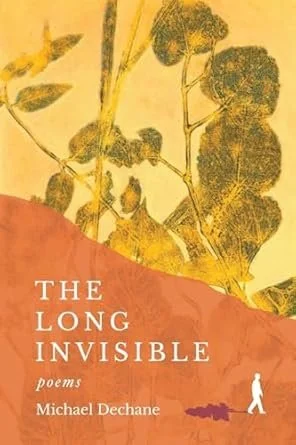
In Michael Dechane’s debut collection, The Long Invisible, we find poems that urge us to “say the unsaid thing” because healing and forgiveness do not come from avoidance but from confronting the difficult moments in life by speaking the truth. In “Round After Round,” Dechane recalls his time as a bartender serving women and men meeting for the first time and describes how he feels as if he’s a catalyst to the problems of relationships:
I don’t hate them, but it’s as if I’m a coproducer
in the longest running show of human history.
I’m tired of watching us be so bad to one another,
making sure I hear nothing, keeping
my mouth shut to save a tip, save this job.
These lines reveal his regret in choosing to remain silent to maintain his income and position and acknowledge the shared responsibility he feels when witnessing people who are “bad to one another.”
"In These Last Minutes," the concluding poem of The Long Invisible, captures the overarching theme of the collection: the necessity to address that which has been avoided. The repeated command, "Say the burning unsaid thing," articulates the urgency of the message of this book. As the poem progresses, the speaker urges us to “[s]ay the names of the unloved. / Say slowly those names you hate.” Imagine that the “ugly, benevolent face” of the "old adversary" might lead to “forgiveness” if we “say the burning unsaid thing.”
—Darius Holmes
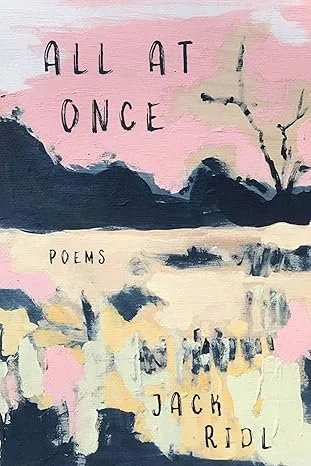
In All At Once, Jack Ridl shows us the beauty of life even amidst the darkness that surrounds us. While the book’s central focus lies in the dark realities of the world such as war, violence, and human suffering, Ridl also reminds us to look to the beauty of the natural world as an antidote to the violence humans inflict upon each other.
In the opening title poem “All At Once,” Ridl begins his book by exposing us to the dark realities of mass school shootings. He starts the poem with a scene that contrasts the narrative of these sinister events—a scene at a “circus” where the “guns” are “plastic” and when “fire[d]” fill “the stands with popcorn.” The speaker seems to long to
. . . . . . . . . laugh like we used to
when no eighteen-year-old
would thoughtfully consider
firing round after round from
a semi-automatic birthday present[.]
And yet the prevailing attitude of the poem toward time is that we cannot turn it back: “It’s always / / too late to turn the page. There / they all stood, taking shot after / shot.” And we are left at the end of this poem with the final irony that the young students who began this day—only “two / days until summer break”—thinking they would soon be walking “out together saying, / ‘See ya at the pool,’ . . . / . . . ‘See ya next year’” will not be able to say these words to their deceased classmates.
Despite conveying that our view of human nature can change from good to bad “all at once” with a school shooting, Ridl does not leave us without a way of finding beauty in such a harsh world. “Once It Happens,” once we stop to experience this beauty, our positive view of the world can be restored. In “Once it Happens,” the father-speaker takes his toddler to a park after dark. Falling “a step or two behind, / [he] heard her chanting / as if in prayer, / / ‘Touch moon. Touch moon.’” After witnessing teen violence, the speaker now, through childhood innocence and the imagery of nature, finds inspiration through his daughter’s eyes, revealing how beautiful the co-existence of nature and humans is.
—Christina Tharu